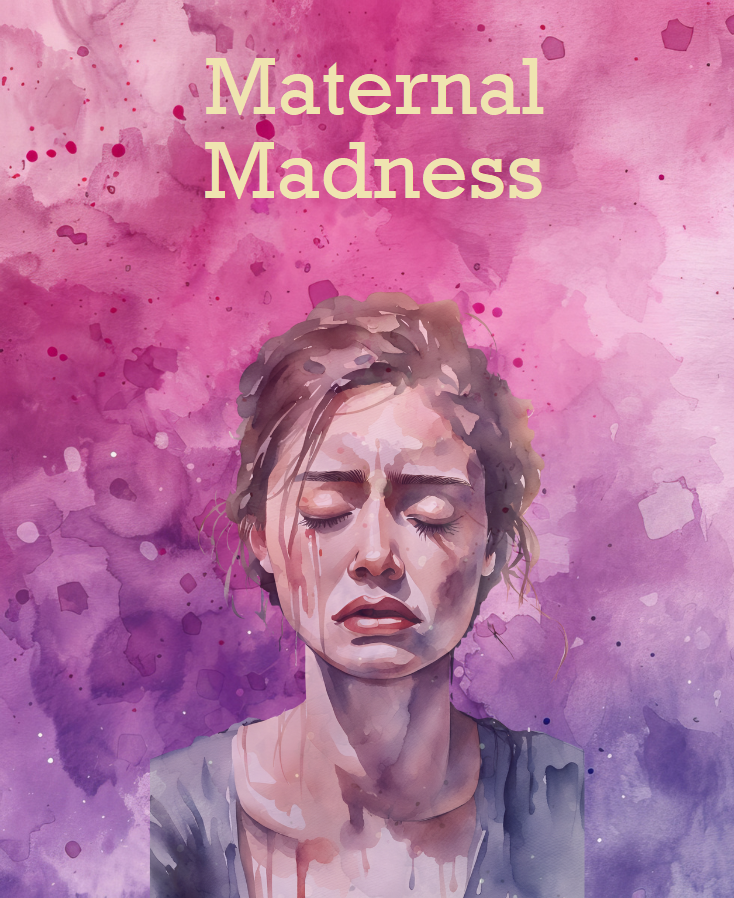
Through out history, women and especially mothers have been labelled mad. While the language has changed across eras, the function has remained the same. Witch, infanticidal, puerperal insanity, hysteria, nervousness, and psychiatric diagnoses have all been used to oppress women who deviate from patriarchal expectations (Ussher, 2011).
Today, Western cultures have made significant strides in developing and enforcing policies that promote gender equality in public places. This movement towards gender equality has given women more access to education, employment and healthcare but “backfires on mothers when equality is achieved in many areas… while inequality still prevails in parenthood.” Forbes et.al. (2021)
The Canadian Women’s Foundation reports that as of April, 2022:
- 68% of moms feel like they are doing more than their spouse to manage their children’s schedules and activities
- 58% say that they are doing more to support their children’s education.
These statistics reflect what many of us already know. How is the invisible labour of parenting divided in your household? Who cooks? Cleans? Does the grocery shopping? Organizes school trip forms, birthday parties, gifts and the social calendar?
As Erica Jong wrote in 2010, “we have devised a new torture for mothers – a set of expectations that makes them feel inadequate, ” and I see the consequences everywhere. Nearly every mother I know under 50 is currently taking or has taken anti-depressants. Mothers are pathologized for having common and predictable human reactions to pregnancy, childbirth, sleep deprivation and the overwhelming pressure to be Good Mothers (link to “Good Mothering” page).
Ussher 2010, points out that it is more convenient (and far cheaper) for doctors, institutions and governments to label a new mother’s distress as a disorder (postpartum depression) that can be “cured” with a pill than to provide the social, emotional and material support she requires to navigate through this significant life transition.
Modern mothers are expected to be good mothers, good partners, good daughters, good friends and good employees, while also finding the time, energy and financial resources to maintain their own physical and emotional wellness. It’s no wonder that 44% of mothers report having “reached their breaking point” (The Canadian Women’s Foundation, 2022)
Who benefits from our pathologization?
“Labelling us mad silences our voices. We can be ignored. The rantings of a mad woman are irrelevant. Her anger is important” (Ussher, 2011). Silencing mad mothers serves many colonial interests:
1. Fathers and male partners
- In heterosexual relationships, pathologizing mothers maintains the gendered division of domestic and parental labour. Ussher, 2010 notes that “many men do not wish to mother. This is perhaps not surprising given the low status attached to parenting in most societies and the power and prestige pertaining to unencumbered full employment.”
2. Employers
- Capitalism depends on reliable and productive workers. Pharmaceuticals which treat disease can numb emotional distress just enough to keep a mother functioning at work, reducing their need for accommodation or workplace flexibility, which can cut into profits. This also allows employers to escape pressure to design and implement supportive policies for their workforce.
3. Governments
-
-
- When maternal distress is individualized and medicalized governments avoid responsibility for:
-
-
- Affordable childcare
- Parental leave
- Income support programs
- Community care options
- Accessible emotional wellness support services
- Creating and implementing legislation to end gender disparities
- Funding holistic health care services that extend beyond prescribing pills.
Home as the next boundary of inequality to dismantle
While public attitudes toward gender equality have shifted, the private sphere has lagged behind. The home remains a site of entrenched gendered labour (Forbes et al., 2021). As Van Hoof (2011) points out “women’s increasing participation in paid employment has not been matched by men’s participation in housework.” The result is a disabling, maddening workload imbalance that mothers are expected to carry, or risk the consequences being judged as a bad mother.
I have relied on many different medications (on and off) for over 30 years, including throughout my own journey as a mad and disabled mother. I understand that pathologization and medication is sometimes the best option to support a mother’s health, wellness and safety. Despite this, I argue that biological malfunction is not usually the root cause of modern maternal madness but that it is socially constructed by our misogynistic society. Many institutions benefit from pathologizing mothers, and medicalization does not address the structural forces that produce our distress.